|
| Hello, borus niger (why niger, it's white! Is it something to do with Greel and Latin, I only did Latin and that would make it black) |
Why won't it let me make the standfirst white so it's actually legible? Grrrrr! And all the ads keep falling off despite my relative geekery. Anyway.
Greetings fellow botaniacs, I'm afraid it's all about seedlings and sprouting bulbs today with it being mid-February, the nights getting shorter and our little island tilting a little more towards the Sun's life-giving energy with every passing moment. (Sorry to my chums Down Under).
The only disaster during the week came in the form of a gift from the primary school next door. At first I couldn't work out what had smashed the seed tray covers and upturned several pots. A fox? No, a football. I've destroyed it, seems a fair trade for a tray of Primula alpicola and some fairly expensive plastic lids. The irony is that if I'd bought the cheap ones (they'd have blown away by now) they'd have been far more likely to survive because the expensive ones shatter. Anyway, I've politely emailed the headmistress (at least it wasn't my window this time) and asked that the pupils desist from aiming balls at pots labelled "Delphinium, species unknown". That's not unknown in the sense of "we've forgotten" but "nobody knows, it's new to science".
I'm about a month ahead of everyone else as my seed doesn't come in those packets with a pretty picture and instructions on the back but usually in an E-dealer's bag from South Africa or Chile. Even the British ones only give you a name and occasionally a guidance sticker to which I have never paid any heed to and yet the roof heaves with the weight of tender bounty destined to die in the winter. But it's the smartypants factor and unhealthy curiosity that keeps me sowing. I've got four jiffy bags backed up with about 40 species in them. Some rationalisation is called for but they're plants! That's like asking a junkie to think rationally about the grade A smack in front of him! At least there are very few actual plants to arrive. 12 species Pelargoniums and 6 Regals for pots on the window are due in March, post-frost, and there's a yellow Lilium martagon and a few bits from Pottertons and Sir Paul Christian and his Rare Plants and I think that's it.
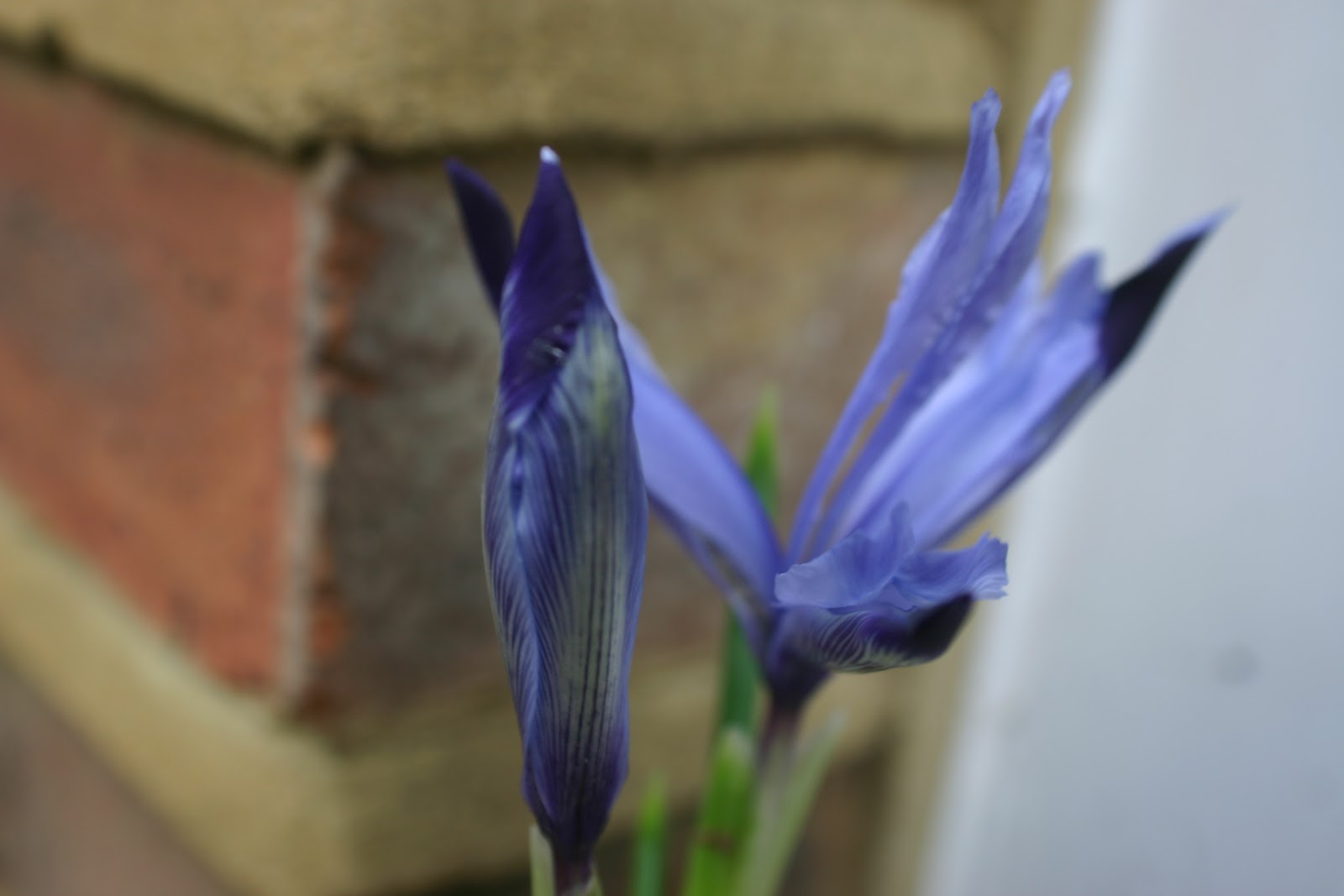
Anyway. The reticulata Irises are slowly fading, apart from the almost white "Natascha", which should is ready to open any minute. Look, here she is: just the merest hint of a blue hue but the nearest we have to white in that particular subgenus.
I shall now bore you with a series of picture of all my Fritillarias coming our of the ground. Even the ones I'd given up hope on have come through and this is without the benefit of a bulb frame or similar. Actually, I was particularly worried about F. raddeana, great big bulb like an Amaryllis but I was using its pot as a backdrop for some of these photos and it toppled over (it's on a long tom) to reveal a very meaty and healthy flower spike an inch or so down, now that I've replaced the mercifully small amount of compost that fell out.
 |
| F. michailovskyi multiflora. Like it's namesake (I'm not typing that again) but with tons more flowers. What's not to like?. For some reason the central bulb's come up weeks before the others, leading me to believe I'd only bought one, so should bet a nice long show. If brown and yellow are your thing. |
 |
| F. pyrenaica. An easy one for the garden, in these parts anyway |
 |
| F. stenanthera. I wet myself when this poked through because instead of just a few nodding brown or green bells, it looks like this: |
 |
| Stunning, n'est ce-que pas? |
Actually I'm very fond of all Fritillarias and somethimes the simplest can be the most beautiful. You only have to look at our native F.meleagris to see that. What, you want to? Time to nick another pic from the web then...
 |
| Thank you, as ever, to the Scottish Rock Garden Club, of which I am a member, even though I don't live there anymore |
Back to showing off my ability to fill a pot with (a carefully but quire randomly) mixed compost, plop in a bulb on its side (it's VERY hard to know which way is up so this way you can't be wrong, you just have to wait a bit longer).
Ladies and gentelan, I give you F. verticillata (syn, thunbergii):
 |
It's a tall but modest member of this genus and I shall now show you how small can be beautiful too:
|
 |
Plane Jane or understated elegance? I'll let you decide
|
Don't worry, we're more than halfway through now! F. Persica is one of the giants of the genus, outdone only by F. imperialis, that most horrible of cottage garden plants the Crown Imperial. You know, orange or yellow bells about 2-3ft hight. Can't stand it and don't think of it as being of this genus, although I know it is. Mum loved it so we grew it in Scotland (so it's hardy as f**k) and I also grew persica in Scotland along with Irises hoogiana and bucharica and all sorts of Lewisias in and shit in an alpine house. She'd ring me up every year when persica popped up. Until she got too ill and had to give up gardening. Not much fun in a wig anyway. Itchy. And she couldn't risk getting pricked and picking up an infection. I'll be back later.
That's better. Right, let's get the rest of the Frits out of the way and move on to the exciting stuff!
 |
F. Persica, just up but wait till you see what it does next!
 |
 |
| F. kurdica "Taylysh". Note the greenfly, which have since been dealt with. Frits are surprisingly prone to aphid attack but they're easy to squish. Failing that a bit of soft soap solution sprayed on drowns them |
This one's from Azerbaijan (well, not that actual bulb, the species) but didn't seem to mind a London winter.
 |
| You'll find a lot of them look a bit like this. Usually the ones with the fanciest names |
And now the prize for the most leaves goes to the easy but rewarding F. uva-vulpis:
 |
| I get the feeling this one's going to multiply quite readily! |
 |
| Growing in conditions more like its natural habitat, Turkey, Iraq and Iran |
 |
| F.carica and friends, since squished! |
 |
| This one's a yella fella, from Turkey, and "best grown in the alpine house". Nah, save that for the Aril Irises |
And finally, because Fritillarias camschatcencis and affinis are too tiddly to bother you with, F. elwesii:
 |
| I'm sure I only planted one. Really! It's in a 4in pot! Still, I'm not complaining, this was one of the last to show signs of life and my, is it compensating! A sunny position and don't let it dry out, yes that ultimate oxymoron of well-drained, moist soil like it gets in Turkish woodland (it's a wonder you can move in Turkey without standing on one these things. |
There are a few failures/late arrivals but apart from michailovskyi (the single variety) I can't remember their names. Actually now that I know raddeana's on its way, that might be it. And I have seedlings of F. whitalli popping up too but it will be at least three years I imagine before they flower.
It's much the same story with these beautys too, Tulipa turkistana, sown late last autumn. I get such a buzz from these things; when obscure seeds germinate it gives me the sort of thrill I get when scuba diving
 |
| Delphinium nudicaule seedlings sprouting. It brought the red gene to the hybridizers so pink could be obtained. I have 6 month old seedlings of D. zalil, an obscure yellow from Afghanistan, so prepare for orange delphiniums at a florist near you soon! |
 |
| The mercifully saved "unknown" Delphinium looking good |
Oh, I've planted up the top layer of the planter with a Camelia, white Pulsatilla vulgaris, Corydalis solida susp solida "Beth Evans" and Disporum megalanthus CD&R 24126 (this is the collection number kept in the records of the expedition team who collected the seed) and will refer to altitude, habitat and where they found it. I also sprinkled both planters with the single yellow Dianthus knappii in the hope they will soften the edges.
 |
| Disporum megalanthus |
 |
| The Corydalis |
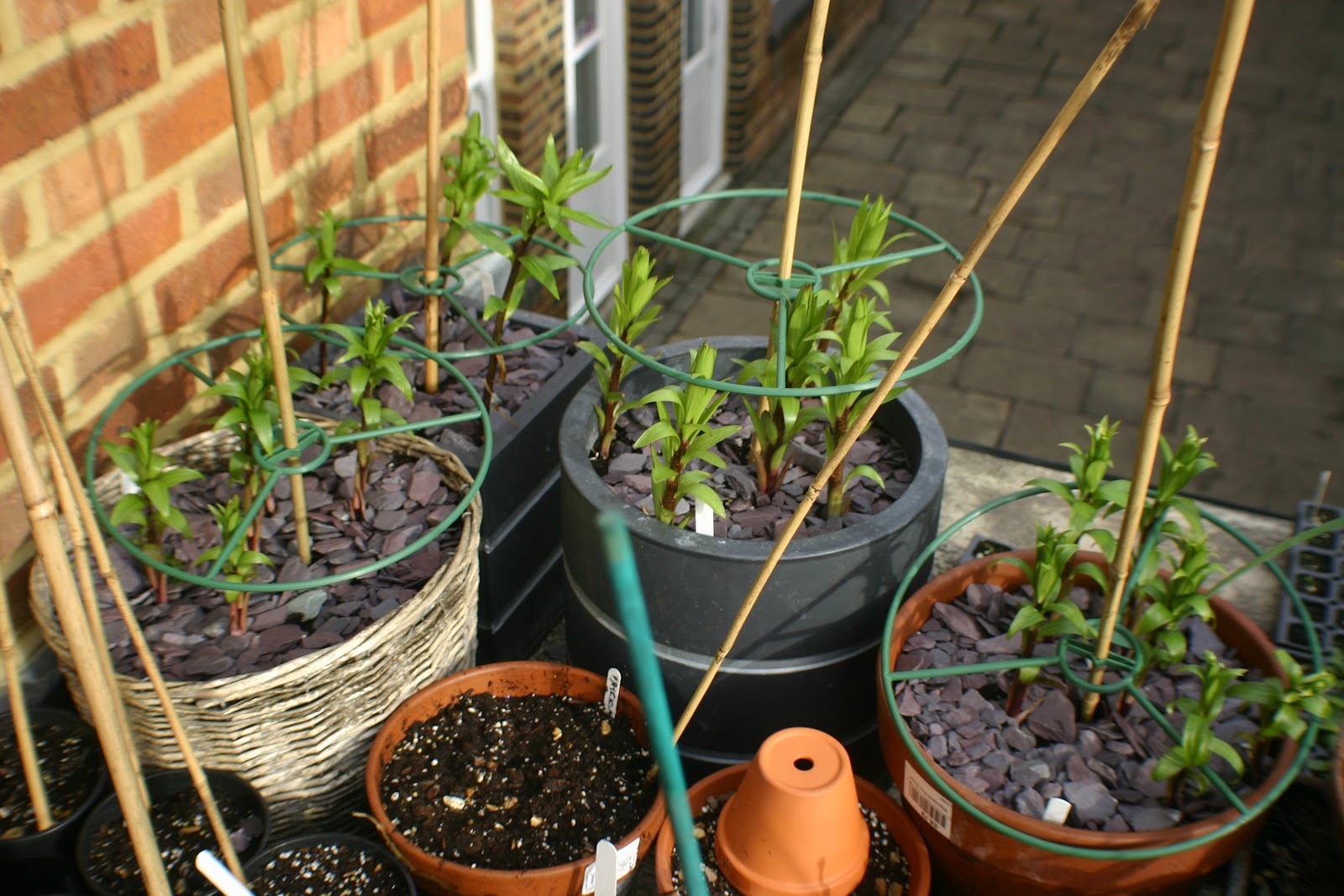
And that will do for now. I'll save up my South African seedlings for the next time. Including that amazing Schitzanthus grahamii with the pink and yellow flowers. The lilies are also reaching for the sky, but that's for another day. Until then, may your garden grow. All the best,
The Plantboy
PS, just been to the flower market held in my road every Sunday (I have to be strong, although most of it is short shelf-life stuff like Phalaenopsis and Hyacinths flown in from Holland where they are grown industrially (battery bulbs if you like) so if I buy anything it tends to be cut flowers as the live ones have been through half a dozen changes of environment in 24 hours and people wonder why the leaves start to fall off when they get it home. Good for xmas trees. They're already dead. However today I paid £6 for a dwarfish yellow (I love true yellow in my Rhodies!) Rhododendron with reddish foliage called "Princess Anne", either aimed at the Commonwealth market or called something else in Zimbabwe.
And I bought some cracking clay pots, really chunky, a "Russian doll" selection of four fitting inside one another, from 3in to 10in, ideal for when the Pelargoniums arrive, as will he the two, foot-tall square ones. Try blowing them over!
But what I wanted to tell you was that Fritillarias minuta, bucharica, pontica, kotschyana, hermonis ssp amana, and latakiensis and acmopetala "wendelboi" will be joing us soon. Now, this should only be attempted by a qualified botanist in lab conditions (I make newspapers) but what you do is gently turn the pot upside down, left (in 90% of us) hand ready to take the contents which will keep their shape. I did this with all of the above and as sell as much root growth, I was actually able to see the lead shoot because a lot had been planted on grit or perlite so the top layer came away to reveal very healthy growth that should be through by next weekend. Bucharica was actually up, it's just the tip was perfectly camouflaged in the flint gravel that topped the pot.
So out of 20 species or varieties of Fritillaria, only F. montana failed due to rot. And it was a cold, wet winter. The only species that had the benefit of the bulb from was bucharica. So don't be afraid to try something that might fail. OK, don't spend up to £30 on plants that might fail but the manuals and instructions are imagining the worst-case scenario. Almost all those Frits should be dead, according to the "experts". They are very much alive and will soon be looking a bit like this:
 |
| F. latakiensis |
 |
| F. minuta |
 |
| F. bucharica (you can tell why i found room in the bulb frame for him!) |
 |
| F. hermonis ssp amana |
 |
F. pontica
|
 |
F. kotschyana (yes, they do get a bit samey, don't they?)
|
 |
And, finally, F. acmopetala ssp wendelboi (it's the green thing, not the blue Muscari in the background)
|
So, let that be a lesson to you: all a plant wants to do is survive and pass on its genes. The last thing on its mind is dying.