Friday, 24 December 2010

This Used to be My Playground part 1

When I embarked on this project in September (the diary, not the roof garden), it was my intention to write about the bearded Irises I had been growing, and the Himalayan plants I have been in love with since long before I made the trip to the Tsari valley some 10 years ago.

However, it has evolved, through my exposure to new and exciting plants from all over the world, into something more than that. It had begun to lean towards bulbous plants, perhaps in a year it will be alpines from New Zealand (I hope not!)

At the moment I have taken to South African bulbs, their beauty being surpassed only by their difficulty in cultivation. Lilies, always a favourite, have come to rival the Iris family (juno, oncocyclus and regalia even) for my affection, coming, like the Iris, so easily from seed although taking rather longer to flower!

If every seed in every packet were to germinate, even though many provide fewer than 10 little embryos, there would simply be no room on the roof. That is a bridge I will cross when I come to it. The fact is I am so enamoured by plants there are times when I just have to have it; it's my life's passion, some would say an addiction, and has been since I was a very small child and my mother would give me a small patch in the corner of the veg patch to grow annuals.

The very first things I grew myself rom seed were mixed cacti (in the greenhouse, not the ground). I also remember some compositae thing, it was called a Chrysanthemum then but probably has about eight syllables now,  (I think they may have been South African, ironically); and ornamental gourds. When asked what I wanted to be when I grew up I would always answer  proudly: "the Queen's gardener".

At four or five years old I grew chrysanthemums like the ones aobe in my little patch, followed by ornamental gourds (below d'oh!)

When I was ten we moved to the countryside proper (not just a village but a house with a sprawling garden of about an acre of extremely fertile Angus clay (the area is world famous for its soft fruit and the house is right on the edge of what was a fruit farm. It has since diversified.
The house was the signalman's where two rail lines met, neither of which have operated for 50 years. But that stuff they use to lay the tracks on lasts a lot longer! The garden was completely exposed to the wind and my poor mother planted shrubs and saplings with a pick-axe. Only now are some of the really common ones: Fortsythia, Cotoneaster, Spirea etc, 27 years later, reaching maturity. Ironically, one of the worst performers was that coloniser of railway sidings everywhere, Buddleia davidii!. Here are some images taken today, I'm afraid you can't see much, it has been like this since November here...

This is the woodland area, taken looking east. Behind is a wall of conifers, not the dreaded x Cupressoparis leylandii but another , gentler hedging conifer which has never been trimmed and is perhaps 20-25ft tall, keeping the wind out perfectly and allowing me to plant so much more!  
Moving 10m forward, everything on the right is growing in clinker, on the left you can just see the edge of the "Magic Circle" which is made of leylandii, largely to prove it is a good hedging plant if you bother to trim it twice a year. It's about 25m in diameter and serves no purpose other than to help break up the garden into "rooms". The Betula pendula is a 25th wedding anniversary present to my parents.

This, honestly, is (was?) Rhododendron Falconeri. It was -10.2C last night 
Those were "mini" conifers when I planted them, expected to reach 2-3ft in their lifetime and that's a Deutzia of some kind on the left
We're on the other side of those "mini" conifers now, looking south. There's a rockery under there. It used to be filled with Bulbinella hookerii, Irises setosa and lacustris, Dactylorhiza fuchsii and so much more. All now either massive or dead.
This is a Magnolia Wilsonii grown from seed 16 years ago.  It began to flower aged about ten.  In the background is an air raid shelter/shed covered in Hederea helix, and in the bottom right is Rhododendron cilipense (a bloody hardy thing for a supposedly tender plant). I also had a blue Flexuosa, Meconopsis punicea, that thing with the with bells... Andromenda polifolia, Erythroniums... not sure what remains... (sniff)
And meet my mum! Magnolia "George Henry Kern", A cross between M. kobus var. stellata and M. liliiflora but more importantly its her gravestone, her ashes being scattered on the excavated soil in 2007. A lot prettier than a lump of granite!


So, there we go, that's where it all started. There is a bulb house, where I grew Irises bucharica and Hoogiana, as well as a lot of the really hardcore Lewisias and others that have long been forgotten, a whole greenhouse with louvres down the side, but I'm not ready to go in there yet.

So I dabbled in Himalayan plants; there was a pond below the rock garden and a bog garden with candelabra Primulas sowing themselves all over the place; the bed with the Deutzia contained blue poppies, Paeonia lutea, Roscoea, Daphnes, Cornus Kuosa, Iris bulleyana, I. chrysographes, I. orientalis, I. graminea, I. maackii, I. sibirica, I. prismatica, I. tenuifolia, I. latifolia and many more of the genus... And then I moved to London and everything changed. So far much of the planting list has been largely in keeping with the blurb at the top of the blog. But over the course of a few months that has changed dramatically.

I'ts not that I've taken anything from it, I've just added to it!

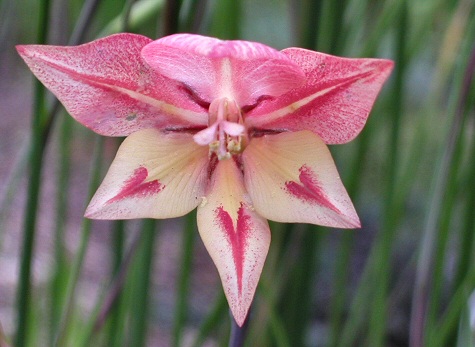
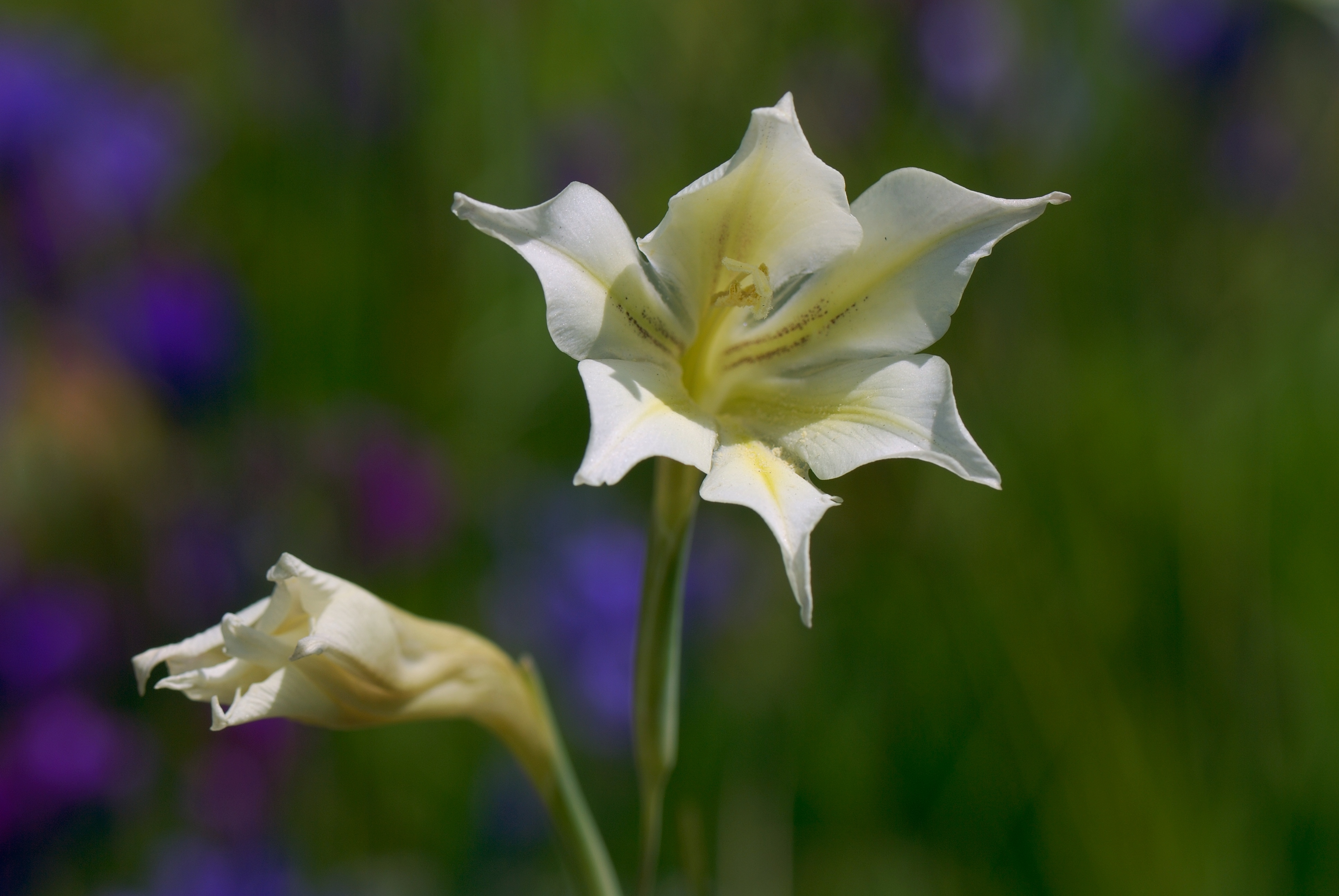
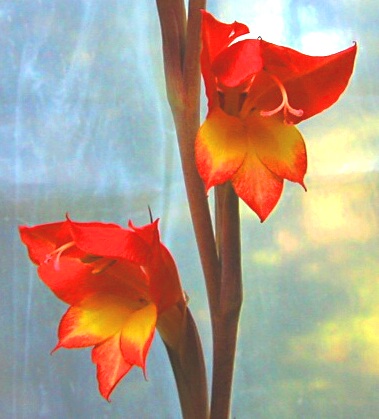
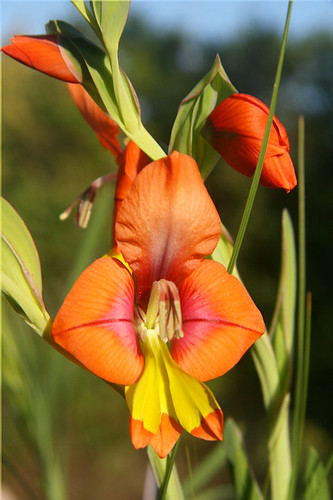
I recently won a load of Gladioli on eBay. There is room for these in clay pots on the window sill after the tulips have flopped. However, the vendor had zero transactions so I'm not getting my hopes up about seeing them. Fortunately PayPal will cover me as I paid a lot for them. Assuming they do come, here they are:

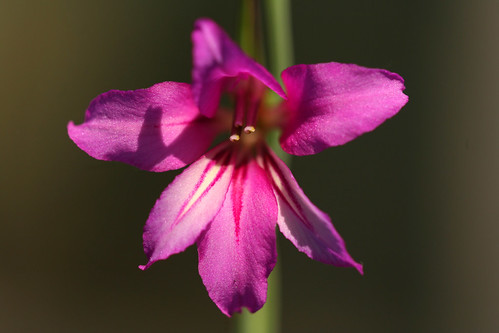
Gladiolus gracilis

G. Saundersii (C)Africanbulbs.com
G. priorii
G. Carmineus
G. brevifolius


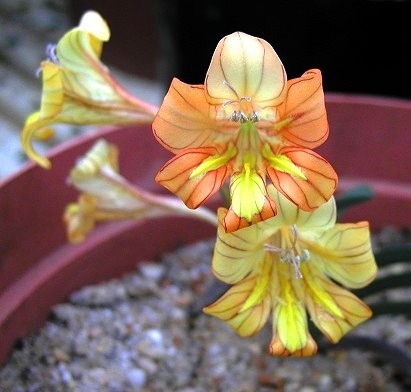
Not a Glad, as the keen eyed and even seriously myopic among you will have spotted but Moraea villosa, a plant that last time is saw photographed was impossibly vivid, so I had to buy one to find out the truth and while it is beautiful, I think we can all agree that the above does not match the flourescence of the following, currently listed on a South African auction site.
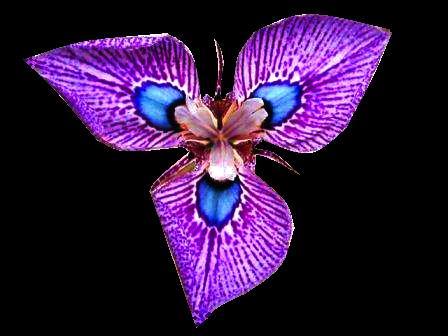

Incidentally, if any readers out there have any tips on growing these in the UK and also on germinating seed (although G. tristis came up like cress). I have steadily acquired seed of other Gladioli and also Moraea, which I've decided fall within my original remit as they are so closely related to Irises. I've nothing better to do except watch awful Christmas TV so I might as well upload pictures of them, starting with the rest of the Glads, which are mostly unsown seed although G. tristis is sown and very much germinated seed. I have hundreds!
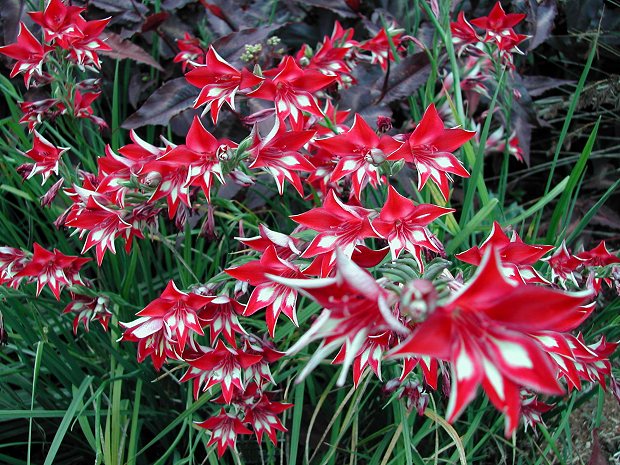
  Gladiolus cardinalis , a stunning image from strangewonderfulthings.com, who officially rock
 (please let me use your picture)
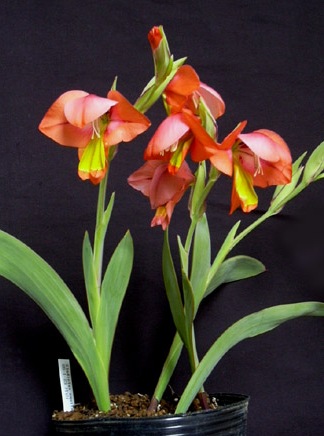
G. equitans, with that beautiful flourescent yellow/green stripe. Sold! Hope it comes easy from seed!
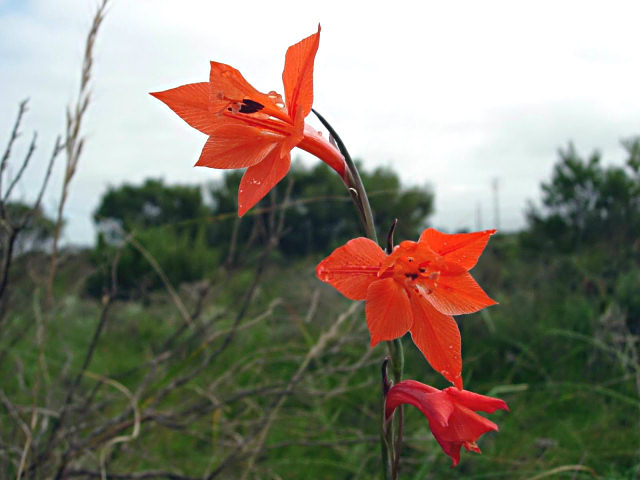
G. teretifolius


G. orchidiflorus
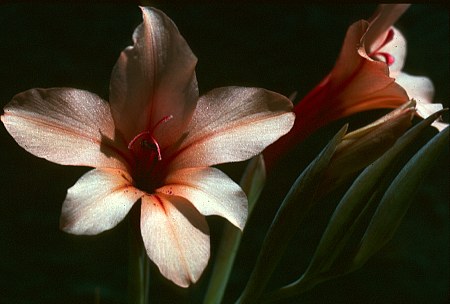

G. miniatus

G. floribundus

G. Flanaganni


Well, that's a bit about where I came from and where the roof is going. In Part 2 I'll be going through the more Himalayan (and Caucasian) treasures I'll be growing this year. And next year, hopefully it will be my macro lens that's taken the photos, not someone elses. On that point, while a lot of these are free to use, if you are the copyright holder and object to my using it, please let me know, I don't want to piss anyone off!

Saturday, 18 December 2010

Snow, squirrels and ciceronian triplets. And Gladioli

Those bloody squirrels! Do the go got the boring free Asiatic Lilies I don't care about? No, they have jolly good scrape about in trays of Meconopsis grandis and M. betonicifolia "Hensol Violet" and try to get at the really expensive Lilies such as fargesii, lankongense and and ciliatum. I know it's cold and they are hungry but they are greyvaliens and they are vermin.

I'm particularly annoyed about the Meconopsis because I've been bragging about how easy they are from seed and urging readers not to be intimidated by the genus. They have a reputatation for being difficult from seed to maturity but they really aren't if you follow a few simple steps and accept that they're short-lived perennials and should be re-sown anuually to ensure a constant supply. The following applies for all the species I have grown, and probably more.
 Use a peat-style compost, sow thinly on the surface and either cover very lightly with perlite or just water with the rose of the can turned upwards so the pot gets no more than a light shower as it's important not to accidentally wash all the seed to one side (there's no substitute for experience!). The water should settle the seed into the surface of the compost so all you need to do now is label (with date) and either cover with a plastic lid if you've used a tray or a freezer bag and elastic band for a pot. Stick in a shady spot outside in Autumn or early Spring and watch the a magic. Should take about a 10 days for the first cotyledons to appear.
I can't show you any of this (Apart from the surviving grandis and betonicifolia I also have integrifolia and have saved a couple of years and bought mature plants of superba and napaulensis) because it's snowing and positively Dickensian out there.

Note extreme lack of space. The bulb frame is hiding behind the green polyhouse. You can see why I've planted Lathyrus Chloranthus and Clematis napaulensis in front of that trellis, it will provide a wall of yellow and later the Clematis should have taken over. On that note, on the left you can see my Clematis tower upon which the four varieties are in various stages of decay, apart from the alpina hybrid "Jacqueline du Pre" which is due to take over flowering dutied from "Niobe" which flowered well until it got really cold. I really hope the general brown appearance of the lower 30cm (1ft) is just winter wear and not the dreaded wilt. They all get hard pruned annually after flowering as container rules are different


Clematis "Niobe" just before the weather turned to sick.

Crikey,! it's a blizzard out there! In the time it's taken me to upload that Clematis another couple of inches of snow have accumulated! It's at times like this that a young man's thoughts turn to South Africa and a ridiculous amount of Gladioli seed. I just can't help myself and G. Tristis germinated so easily, and is thriving in the current climate, I'm not as  intimidated as I was.

These G. Tristis came up like Cress, all over one night, about two weeks after sowing. There are about 100 seedlings, which should look a bit like this:.

So, as usual I've gone mad and bought seed of probably every species of Gladiolus that exists including Gladiolus splendens

So, as usual I've gone mad and bought seed of probably every species of Gladiolus that exists including Gladiolus dalenii


G. miniatus
G. alatus
G. gracilis
G. floribundus
G. venustus

G. papilio "Ruby"

G. communis ssp. byzantinus


This plant of G. papilio gave me a real surprise when I repotted it: just look at the amount of offsets! I didn't really know what to do with them so `i just put it in a much bigger pot so they could find their own way to the sun. Apart from byzantinus  and the tristis seedlings, these are the only living Gladioli I have, the others are seeds and therefore dreams
G. papilio in flower. Photo: Banwy Valley Nursey
These are just the ones I got on eBay, I have many others from other sources but you get the general idea of what they look like: nothing like those awful gaudy hybrids! Obviously hardiness is an issue although most are tougher than you'd think: it gets mighty cold during the night in some of southern Africa from which these come. 


From seed they should flower in their second year although I won't be able to give away seed as they'll all be growing so close to one another the bumblebees will be making genetic graffiti!


I've acquired some more Irises and Lilies, both seed and bulb, but more about them when I don't have to head into Oxford Street to buy toys for my nieces.


But here are a couple of seed purchase you couldn't make up:
 Lapeirousia silenoides
Tritonia karooica


Enjoy the snow, think of it as a blanket on your plants, happy Saturday, the plantboy.


STOP PRESS!!!!
I have just been back to the post office depot having gone once already at 7 this morning. More in hope than expectation I went back in the early afternoon as it was supposed to be open until 3pm due to season and a minor snowfall causing delivery delays of weeks. Amazingly, my package was there. It could have been a Christmas present for my other half I'm also waiting for but there was clearly plant life in that box.


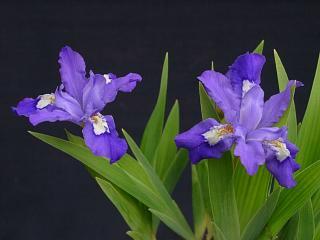
On getting it unwrapped it was little 9cm pots of Irises cristata and gracilipes x lacustris. I'm familiar with  Iris lacustris, having grown it with great success in Scotland in the rock garden. It's a tiny little thing no higher than 10cm and spreading out on a mat of rhizomes (leaving a "dead" patch in the middle" so occasional division, replanting just the healthy outer parts. It looks like this:


Iris gracilipes I have no prior experience of but it looks much the same only a bit taller and bushier:


Quite why someone decided to cross two largely similar species (the Great Lakes, meet The far East)  to create a largely similar hybrid I do not know, perhaps it has greater vigour or more/bigger flowers. Anyway, cross it they did and it seems to have been regarded as a success because you can buy your very own ready made one today. Here it is:


Actually the flowers are held above the foliage and have rather grand falls so I can see the attraction. And I'm glad to have one. It will go straight in the strawberry planter should it ever arrive. Oh, mine looks like this:
I'm sure it will get bigger as soon as the temperature stops playing silly buggers
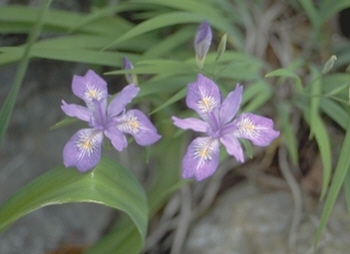
So to Iris cristata, a native of the eastern US and a close relative of I. lacustris and similar in appearance.


THAT is GORGEOUS! what a stunner! I don't know  if the photographer (not named but thank you, you take a mean snap) got lucky or if it's always this floriferous? Do you really think I can get one of them out of one of these?


Of course! Gardening is 90% optimism and 10% cockiness

Tuesday, 14 December 2010

The Cape of Much Hope

wHello and welcome to the blog that shows you how to fill your roof terrace with plants and then, when it's creaking dangerously, buy some more. However, I have hit on a new formula for hiding this fact from your partner/landlord/owner of cafe downstairs upon whose roof the aforementioned collection of Fritillarias, Irises, Rhododendrons, Clematis, Pelargoniums, Lilies and many, many other amazing plants grow. In pots. Because it being basically next door's roof, there is no soil.


Today one important piece of the chocolate box that is this al fresco fresco, my experimentation with South African plants, leapt a step closer to working out. On Friday the Royal Mail "attempted" to deliver a large package from  Cornwallplantaholicsltd but of course with the house being occupied and the driver having filled in the red "sorry we missed you" cards for all the bulky stuff before he'd left the depot and left them there 'cos they do weigh down a bag, I had the frustration of getting up at 6am on Saturday, Monday and today to for the 20 minute walk to the depot and the far longer wait in the icy blast outside and then inside, where they have reacted to the increase in post due to the season and the problems with the weather by reducing the number of staff by 50%, from two to one. So my parcel had gone missing, which is odd considering I bet it never left it. You can usually pick it up the next day. Mine finally popped up today. I was concerned as these are live plants we are talking about but they turned out to be stunning specimens.

From left: Wachendorfia thrysiflora, Hedychium densiflorum or Ginger Lily, Libertia grandiflora and Dietes grandiflora


Now, cleverclogs, I know Libertia is from New Zealand and the Ginger Lily is from sub-tropical parts of the foothills of the Himalayas in India, but one day at a time. With the possible exception of the Libertia (bit dull), these are lovely plants and will help to determine just what  I can get away with in terms of hardiness as the Dietes is right on the border of 0C,  which, if I live in Altnaharra (-21.1C), I'd probably have lost a few leaves by now.


Handily, they all like a very free-draining humus soil so I took them out and potted them up in the remains of a rotting bark/perlite/MiracleGro all purpose and slow release food granules I'd prepared for something else (oh yes, Rhododendrons) but giving what I hope is the right mix of humus (enter pitta-based joke here yourself) and drainage. They're in clay pots because a) they're slightly less likely to fall over and b) if I overwater a clay pot dries out a lot faster than plastic; a curse and a blessing for those who don't like climbing in and out of windows with hoses and watering cans full of specialist bulb food which has extra potash for bulking up bulbs.


Wachendorfia thrysiflora grows along the edges of streams so needs a lot of water but doesn't want it to stay in the pot very long. That's taking the already oxymoronic notion of a moist, free draining soil  and just making it even sillier!


Call me on old pedant if you want but i become annoyed when people lump Dietes in with Irises in their catalogues etc. Yes, grandiflora is in the Iridaceae and does a bloody good impression and, without being able to read books, I'd be fooled too. But it is of course a distinct genus with many beautiful species, one or two of which I showed you yesterday. Another genus which suffers this confusion is the Moraea, largely because of huttoni, which I'm attempting from about half a dozen seeds (this maximum quantity of about 12 seems to be a foreign thing and I suppose, if you're just after one specimen and a back-up, it makes sense by keeping everything small: pot, compost etc. I presume if you buy a packet of Foxgloves in America you get 100+ seeds?)

Spot the difference


Here we have, from top, Moraea huttonii, Iris wilsonii and Iris forestii, although there is a constant battle among the taxonomists over the two Irises. It's not one I wish to get involved in but they do look very similar. I. wilsonii is the yellow end of a spectrum for the species that ends with bluey purple. In other words, it's very variable. I am led to understand that I. forestii comes in any colour as long as it's yellow, although there are slight variations in shade and probably a white form, most species do. But my point is, they all look very similar to all but the most keen follower of Irises. And my other point is, it had opened up a whole new, largely South African, genus for me to plunder, the Moraea, which followers will have seen me get excited about recently.


Can I just show you one?
Amazing, eh? If I can get things like this surviving on the roof I will be a very happy plantboy!

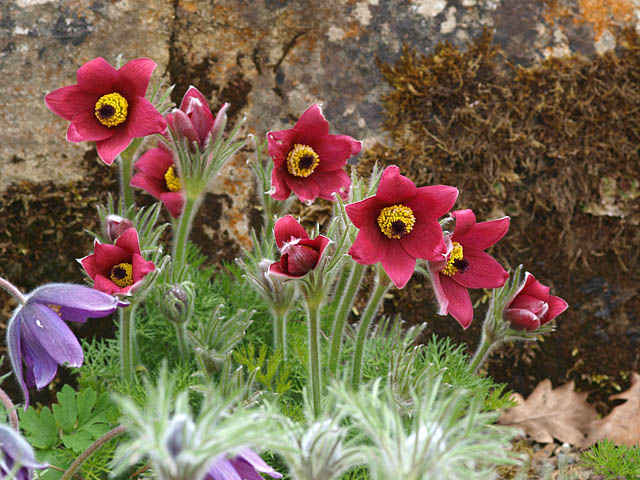
And so to today. Apart from dealing with the delivery, I decided to sow some seeds, not expecting any germination action for a month or three but the seeds of some, such as the three species of Pulsatilla, need to spend the winter  outside  so P. vulgaris (red form), P. sulphurea and P. dahurica were sown and,  as the clearly erudite instructions said, barely covered. I used perlite for this because I don't trust myself to spread a thin layer of compost so I hope it doesn't just blow away. Actually, Tesco freezer bags are ideal for zipping up the biodegradable pots I'm using (they're about the size of a CD (5in) but shallower than you might expect) so I'll do that to make sure none of my FIVE seeds of P. sulphurea blows away (or if interfered with whatever is causing havoc out there every night. It dug up most of a tray of Meconopsis Grandis last night and is really keen on Lilies (I receently spent £80 on the most amazing Lilies such as fargesii, below)


But back to the Pulsatillas. If they germinate in time they should flower in 2011.


From top: sulphurea, vulgaris, red form, dahurica


Also today I sowed Lilium Pumilum, even though I have small bulbs of it,  L. ex Royal River (no idea what to expect from this as I don't know the parentage, and Anthyllis vulneraria var. coccinea


Quite what to expect from the Ex-Royal River hybrid I have no idea. The seed company are specialists so they know what they're doing.  Is the idea to get a seedling that look's like the parent (boring) or are we hoping some genes from way back make a reappearance (interesting, although I don't like those stumpy lillies with the upward facing blooms like that).

Anyway, that's all for now, short one today, will update on, well, everything. Good luck with the weather, whatever it brings. 

The Plantboy